In recent times, conversations around sustainable development in Nigeria have begun to shift, moving away from isolated interventions toward more inclusive, people-driven approaches. One such shift was reflected in a recent multi-stakeholder dialogue held in Imo State, where government actors, civil society organizations, development partners, and community voices gathered to reflect on the progress of the Sustainable Development Goals (SDGs) and, more importantly, to rethink the path forward.
At the heart of the engagement was a simple but powerful idea: sustainable development cannot be achieved in silos.
Creating Space for Honest Conversations
The dialogue created a much-needed platform for stakeholders to speak openly about what is working, what is not, and what needs urgent attention. For many participants, it was less of a formal conference and more of a collective reflection space; where experience from the field met policy, and where community realities challenged institutional assumptions.
Civil society actors highlighted recurring gaps between policy design and local implementation. While frameworks for SDG delivery exist, they often fail to translate into meaningful change at the grassroots level. This disconnect, participants noted, continues to hinder progress across key sectors such as health, education, gender equality, and environmental sustainability.
What stood out was the willingness of stakeholders to move beyond rhetoric. The conversations were practical, sometimes uncomfortable, but necessary. There was a shared understanding that progress requires more than well-written plans; it demands collaboration, accountability, and sustained engagement.
The Role of NGOs as Connectors
Non-governmental organizations played a central role throughout the dialogue not just as participants, but as bridges between communities and institutions. Their contributions underscored the importance of grassroots insights in shaping policies that are both relevant and inclusive.
NGOs working across Imo State emphasized that communities are not passive beneficiaries of development; they are partners. When local voices are intentionally included in planning and decision-making, solutions tend to be more sustainable and culturally grounded.
Strengthening Partnerships for Greater Impact
One of the strongest themes that emerged from the dialogue was the need for stronger partnerships. Achieving the SDGs requires coordinated efforts across sectors; government, private sector, civil society, and communities must work together, not in parallel.
Participants acknowledged that while partnerships exist, they are often fragmented. Moving forward, there is a need for clearer alignment of roles, improved communication, and shared accountability frameworks. Collaboration should not end at meetings, it must continue through joint implementation, monitoring, and evaluation.
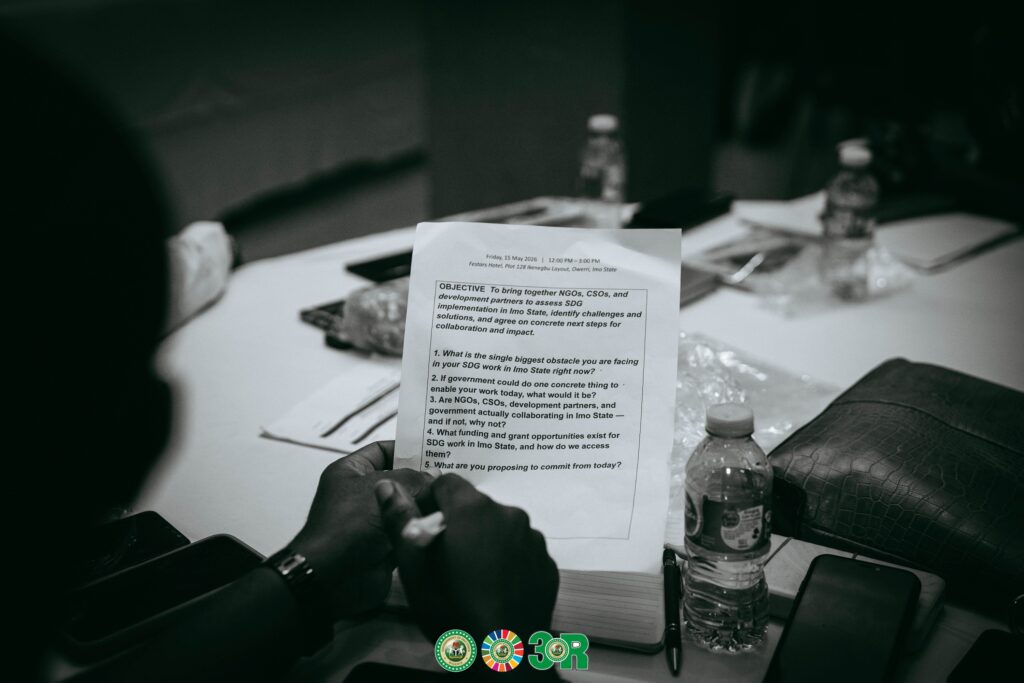
There was also a call to leverage data more effectively. Stakeholders stressed the importance of evidence-based decision-making, noting that accurate, accessible data can help identify gaps, track progress, and guide interventions where they are most needed.
Localizing the SDGs
Another critical takeaway was the importance of localizing the SDGs. While the goals are global in nature, their success ultimately depends on how well they are adapted to local realities.
In Imo State, this means designing interventions that reflect the unique social, economic, and environmental context of communities. It also means empowering local governments and community leaders with the tools and resources they need to drive development at the grassroots level.
Participants urged stakeholders to shift from top-down approaches to more participatory models, where communities are involved from the beginning, not just consulted at the end.
A Shared Responsibility
Perhaps the most important outcome of the dialogue was a renewed sense of shared responsibility. No single actor can achieve the SDGs alone. Progress depends on collective action, on the willingness of different stakeholders to listen, learn, and work together.
For NGOs and CSOs, the path forward involves deepening community engagement, strengthening advocacy efforts, and continuing to hold institutions accountable. For government actors, it means creating enabling environments, investing in inclusive policies, and prioritizing transparency. For development partners, it means supporting locally driven initiatives and fostering long-term sustainability.
From Dialogue to Action
While conversations are important, participants were clear that dialogue must lead to action. The real test will be how the insights, recommendations, and commitments made during the engagement translate into concrete steps in the months ahead.
Encouragingly, there was a shared commitment to keep the conversation going through follow-up engagements, collaborative projects, and continuous learning.
And if sustained, this shift could be exactly what is needed to move closer to a future where no one is left behind.